Showing posts with label brain exercises. Show all posts

Monday, July 21, 2014

Your brain on jazz: a not so sudden realization

I was driving to work the other day and some dumb-ass pulled out in front of me and proceeded to make a right turn about 400 feet up the road, keeping me at about 20 m.p.h. on a 55 speed limit road, all when there was nobody behind me for at least a mile (because that’s how far you can see down this particular road that I drive on every morning). A few years ago, a stunt like that would have made me give you the finger, probably a honk of the horn, and maybe even a flash of the brights. This particular day, I didn't even react, other than to note that I was not reacting to something that would normally have badly pissed me off.

Last year, when we were putting up new blinds and installing hardwood floors throughout the house, I was nervous that things wouldn't turn out well, but I consoled myself with the thought that, if anything didn't work out, we could always buy another solution. Maybe it would be a waste of money, but if it was, so what? It’s just money. So, when one of the new blinds ended up being not quite right, did I storm back to the store and demand a refund? Nope. I just put it up, fixed it as best I could and left it, and will wait for a better solution at some point in the future. It doesn't bother me a bit.

At work, some of the staff have been decorating the office with cheesy pictures, plastic plants and new modular furniture, all in anticipation of the boss’s arrival for a visit this Thursday. In the past, I would rant, make comments, and generally try to undermine their efforts. I would lecture them about how we are running a business, this isn't your house, and quit wasting the company’s money on that junk. Now, I actually helped them hang a bunch of pictures and I assembled their furniture for them. Yes, I made a few comments about my potential bonus being wasted, but nothing biting or acerbic.

As all this has been happening, I stopped and asked myself: What gives? What happened to the driven, obsessive, get-it-right-at-all-costs me that I was so used to? Why am I so calm and why is my short temper now so long (if it exists at all)? In short, what happened to the real me?

I look different, but feel the same.
I think certainly age figures into it. At 50, you begin to see how much closer you are to your mortality as opposed to your nativity. Small things fade away to nothing, big things fade to small things, and life is much easier. But I don’t think that’s all there is to it. I honestly think that listening to jazz and playing the piano with a mind to play jazz music has rewired me. Since taking up jazz seven years ago, I realize that I get excited playing the piano. I’m happy just looking at my baby grand. I’m fascinated by pieces of music I haven’t heard before, or subtleties and nuances in songs I’m well familiar with that I didn't notice before. I don’t just think “cool”, I feel “cool”. Putting on one of my hats makes me look jazzy, and that makes me feel, I don't know. Free, maybe? Music has released me from the tedium of working in a factory and gives me a specific thing to look forward to at the end of each day, whether I’m going to a concert, going to a piano lesson, or just going home to dinner with Wynton Marsalis or Bill Evans playing in the background. Pull out in front of me and slow me down, that’s a few more minutes to explore Milestones or Maiden Voyage. Set me up with some appliance to install or a garage to clean or a bookshelf to build, the iPad and speakers will be Blowin’ the Blues Away, unless I need to Take Five. Decorate the office with some plastic bamboo, and I will forget all about it when I’m looking at the clarinet I’m going to hang on my wall at home. I’m the new Alfred Neuman: What, me worry?

I really believe that jazz has completely changed my brain and the way it works, which in turn has changed my life. If you don’t want to sweat the small stuff, try some Ellington or Basie. Like the guy on that commercial says, “It worked for me!”

Tuesday, February 12, 2013

Playing stride piano and one degree of serendipity

(None of the photos in this blog entry were PhotoShopped. Believe it. Not because I say, "believe it", but because, it is true!)

Last week, I started in earnest to learn how to play stride piano. Since I’m so weak with my left hand, I figured, if I learned to play stride, I could eventually do anything. Stride piano, however, is extremely difficult. Nothing I have ever attempted on the piano before has been as challenging as making my left hand play something that is completely different, both in notes and rhythm, than my right hand. I have many times started to learn stride, only to stop as my progress was too slow, or so small as to be completely discouraging. But then, I had a thought: Once upon a time, I couldn't play a ii-V-I progression. I couldn't play a Miles Davis tune, or a jazz waltz, or, anything. Eventually, I learned. So (I pointed out to myself) stride should be the same. Today I can’t play it. Someday, I will be able to. And sure enough, I started with a simple four bar phrase that changes chords twice per bar, and, tried to play it, and hacked it, and hacked it, and hacked it. I did this for three days, for twenty or thirty minutes each day. (Just ask Mrs. S how she’s liked my playing the last week if you don’t believe me.) Then, about two days ago, I sat down, no music, no metronome, no nothing, and played it straight through four times with no mistakes. Four bars down, 124 (or something) to go.

The first moment of serendipity - not distracted
Really, stride is about distracting yourself. If you can reach the point where your fingers, hand, wrist, and arm move on their own, you can turn off the conscious part of the brain that controls that activity, and focus more intently on the melody in the right hand, or the music overall. It’s sort of the opposite of consciously pursuing something that you experience unconsciously every day.

Like the temperature.

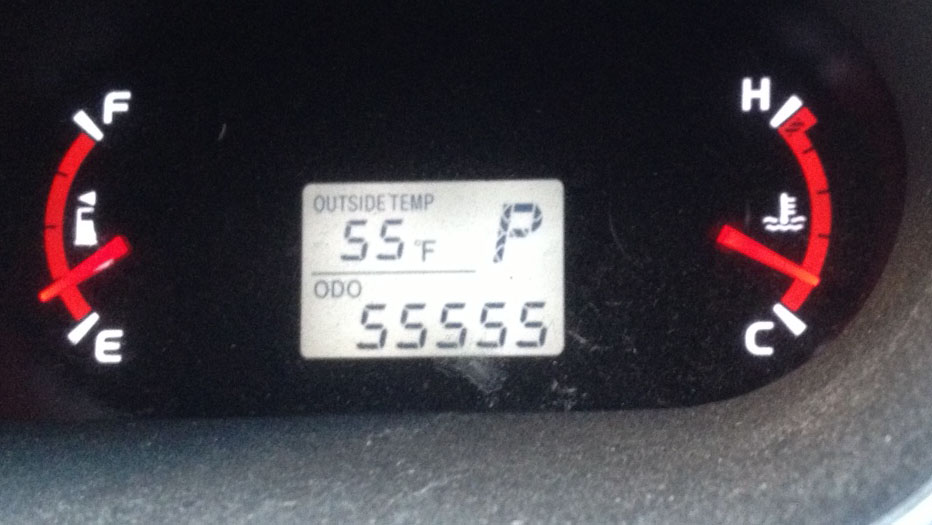
55 degrees is not unusual in February in Alabama. It’s not typical either. I’d sort of had in the back of my mind the last week or so, that with any kind of luck, I could find myself in 55 degrees of heat or cool when my car odometer flipped to the 55555 mile mark. Yesterday, after driving home from work and then around the block a few times, my car odometer was at 55555, but alas, the outside temperature, after peaking around 57 in the afternoon, had dropped to chilly 54 during my ride home. 

One degree short of serendipity - like stride piano on the second day of trying it: just not coming together
I parked the car, closed the garage door, and turned on a bunch of portable floodlights. I checked the car every half hour or so. It never budged above 54. I was one measly, but stubborn, degree Fahrenheit from serendipity. But I can do nothing about the weather, so, I gave up and went to bed.

With the temperature dipping into the forties overnight, I’m not sure how my garage got up to 59 degrees – a question for my HVAC guy I guess – but that was the temperature of the car when I got in it this morning. I pulled out of the garage and into the driveway and waited for serendipity, Like a semi-miraculous play-through of a four bar stride pattern, it all came together: nothing but 5’s on my dashboard. (First picture, top.) Eleven miles and eleven degrees later, as I pulled into a gas station to gas up, it came apart in tandem. Together again. Weird.

Day four of playing stride piano: stuff comes together without thinking about it (Notice the gas gauge ever so slightly - eleven miles' worth - lower. I repeat: NOT PhotoShopped!)
Stride piano, my odometer, the temperature in February, and my consciousness, all in a state of serendipity. Just keep going, and stuff comes together.

Friday, January 30, 2009

Don't think - it's harder done than said

The key to listening is to pay attention to what "kind" of listening you are doing. I find that I hear things differently when I am focusing on the music - just sitting and listening - as opposed to what I hear when I play background music while I'm eating or painting the garage, but also as opposed to what I hear when I'm sitting at the piano listening to something I'm trying to play. I see sort of intuitively why this might be, but I don't really understand it. The music isn't changing, and neither is my brain, per se. I think it comes down to what you are listening for.

When I sit and listen to music (which is a relatively rare occurrence), I generally don't listen for anything specific, but I do hope - and therefore I guess I listen - to hear something I never heard before. A subtle nuance in a certain note, or maybe a click of the bass string during a solo that adds a rhythmic touch. You never know what to expect with a new recording or a recording you haven't actually sat and listened to, so it is impossible to quantify beforehand, but I think there is something to it.

When music is just in the background, you hear something, but you don't really acknowledge what. So ultimately, only something that grabs your attention actually makes it to the foreground of your brain to be recognized and "heard" heard. In a sense, it isn't really listening at all, but nonetheless, I've had profound moments of constructive hearing while engaged in some mundane task, such as when I rediscovered Eric Dolphy while, that's right, painting the garage.

The ultimate listening for me, however, is when I'm learning a tune. If I'm seated at the piano and playing a CD over and over again, after a while, the way I hear the music, and what I actually hear, changes. Some parts of the song don't even exist when I'm listening that way. I may be interested in a rhythmic pattern or discovering a fill, or something along those lines, but then it becomes necessary to ignore parts of the song to hear certain other parts. That sort of listening I have done, but not yet mastered. Fortunately, I've found a parallel but unrelated skill that helps.

Sometime back I read about a relaxation exercise that involves stopping thinking. The human brain has a continual and unending stream of thoughts, generally not even interrupted for sleep, as far as scientists can determine. The exercise involves training your mind to not think of anything. It sounds easy but is deceptively difficult. In fact, it is damn near impossible. I have been practicing this exercise now for about two years. I can successfully stop all thoughts for what I estimate to be ten seconds or so. (I can't time it, because then I would have to think about that, and that would ruin the exercise.) Again, you have to NOT THINK ABOUT ANYTHING. Not your breathing, not about how dark it is behind your eyelids, not about the heartbeat you hear in your ears, or ANYTHING ELSE. Like I said, this is extremely and deceptively difficult. But, when I do this before listening to music, I do hear differently.

I don't know what any of this means. Just thought I would share it with late-to-jazz readers. Maybe someday I'll have some further perspective and better observation to share on this.