Showing posts with label jazz books. Show all posts

Saturday, September 2, 2017

Something worth reading

I read about jazz every chance I get, so when I was offered a review copy of pianist Fred Hersch’s memoir, Good Things Happen Slowly, I gladly accepted. What follows is an edited version of a review I posted on Amazon.


Prior to reading this book, I was only vaguely aware of Fred Hersch and his accomplishments, and then, mainly only his work as a record producer. To find out that he is an accomplished pianist, composer, advocate of various causes, coma survivor, and now a writer, was a real revelation. Early in his career, he played with a lot of jazz luminaries who unlike Mr. Hersch, were late in their careers. Those nostalgic kinds of stories about late jazz legends are always enjoyable, especially for the perspective they give about bygone jazz eras. I was also interested to learn that he is a fellow Ohioan who is close to my age. So even though I do not share his sexual orientation, which drives a number of his storylines – and obviously, portions of his life – I found his tales highly relatable and not entirely without correlation in my own life. That sort of thing always makes for good reading.

I will say, however, that Mr. Hersch is not the best writer. What was really surprising is, I thought that the main thing lacking from his prose was rhythm. He just chooses too many goofy, not completely accurate words, so when the narrative starts bouncing around, there was a tendency to get lost and lose the entire track of the narrative. Then I would have to go back and reread passages to piece the story back together. It’s just like playing in a jazz combo, too, in that when the rhythm isn’t there, the musicians tend to make bad decisions. I think that is why his word choice was not always correct, where what he wanted to say was somehow conveyed, but in a convoluted or “out of rhythm” fashion. He also drove me crazy calling a cello a ‘cello. I thought that was just plain obstinate, especially because it wouldn’t have been much of an issue except he has worked with a lot of ‘cellists who play ‘cello.
The book will be on sale September 12, 2017.
For the most part, I enjoyed this book, but it was a bit dark and melancholic at times, maybe even morose. Just the same, Mr. Hersch has certainly led an unusual, and at times charmed, life. If his writing was as good as his music, this book would have been a lot better, but it’s still a good look at an interesting corner of the jazz world.

Saturday, April 2, 2016

Miles from everything

I went from reading a biography about Thelonious Monk to reading this autobiography by Miles Davis, and I have to say, you would be hard pressed to find two more diametrically different books about jazz artists. Where the Monk book was carefully researched, cross checked, and objectively constructed, the Davis book is filled with suppositions, vague recollections, and biased, one-sided editorial comments. Of course, Miles Davis and Thelonious Monk were also two completely different kinds of people, one rich, outspoken and philandering, the other poor, quiet, and dedicated to his family. Really, the only thing these two jazz greats share is their love of, and their impact on, jazz music.

Not your average autobiography

One thing that drove me crazy about the Miles Davis book is his (and his writer’s) insistence on not checking anything. There are pages of anecdotes that begin or end with comments like, “At least that’s what I think happened,” or “…during that year, or maybe the year after, or the year before, I don’t remember.” Really? You can’t call someone and ask them when they came and bailed you out of jail (or whatever)? Then there’s the “I don’t want to say who it was, because they are still alive, but …” and he then proceeds to lambaste this person were supposed to guess about, but later in the book, he’ll write pages about how much he hates Wynton Marsalis, or how Dizzy Gillespie is pandering to white people and businessmen, or how some (evil and white) record producer screwed him over. I guess it’s okay for him to draw random lines with his hatred, but it doesn’t make for the best reading.

Also telling for me was how he glossed over the fact that his was a privileged upbringing. With a well-respected dentist father and a musically inclined mother, Miles and his family owned, land, stocks, buildings, cars, all the trappings. Just being aware of that makes his railings against white-dominated society sound hollow and contrived. And I don’t want to start or continue a big racial argument, but it seems to me that Miles only played the race card when it was to his real or perceived benefit. All the rest of the time, he was perfectly content to take white people’s money and bask in their adulation.

There are no two ways about it: Miles Davis was a polarizing character in the world of music who neither invited controversy nor did anything to avoid it. As a result, it is hard to take anything he says at face value, even when he is talking about his own life. I found it oddly curious, too, how after reading about Monk, I wanted to explore his music and learn more about it, get deeper into it, but while reading Miles’ book, I didn’t have any curiosity or desire about his work fanned inside me. Probably the fact that I am already well familiar with Miles’ music and the fact that it played a role in setting me on the path toward learning and playing jazz in the first place have something to do with it. But I would have thought I would feel at least a small spark of passion to explore something, anything, of Miles’ work based on what I read about it. But when I finished reading, I was maybe not disinterested, just not willing to expend any extra effort to experience his music. (While reading Monk’s biography, I bought 6 CD’s and two books of sheet music of Thelonious Monk – quite a different reaction.)


I’m still glad I read this book, and I feel like I learned something. I just feel like the time spent didn’t have quite the payoff I hoped. At least that much is completely unlike his music, which pays off every time I listen to it, so I suppose I am simply more grateful for the music itself than for its history. That’s just as well.

Saturday, March 12, 2016

Reading that makes me play


I just finished reading a biography of Thelonious Monk by Robin Kelley, a very serious and enlightening look at one of the greatest jazz artists who ever lived who I didn’t know was one of the greatest jazz artists who ever lived. I say that because, of course, anybody who knows anything about jazz knows about Monk, but for me, he was just one of those guys who wasn’t worth approaching. I suppose I was “contaminated” by reading an article about the great pianist Dick Hyman (who I do respect and admire) who said something in a Wall Street Journal piece like, “I don’t appreciate Monk. His music doesn’t sound right and I think most of the time he’s just hitting wrong notes.” That kind of embodied how I felt and I didn’t think I was missing anything by giving Monk’s music short shrift.

The subtitle says it all.
As I was reading Mr. Kelley’s book, however, some things about Monk started to make sense. I started to see what kind of person he was and how that could lead to him being ignored, or overlooked, or even ridiculed. Then too, Mr. Kelley does a great job of illustrating the formulation and evolution of a lot of Monk’s work, and it caused me to revisit some of the tunes. And whaddaya know? Here I am almost ten years down the beginner’s jazz blog road, and things I never understood started making sense.

I can’t really cite specific examples but I can say this, when I read about a song and then the next day pulled out the lead sheet and started to play it, suddenly Monk seemed not only approachable, it seemed like playing his music was helping me achieve things I could not before that point. It’s hard to put clearly, but, I started to see how Monk is more or less the next level I need to go to. But what that really means is, if you can play Monk on Monk’s level, I started to feel like I could probably play anything.

Haven't found any Miles Davis beer yet. I'll buy it and drink it if I do.
Now, I’m not suggesting that if I work out all the changes to Epistrophy, I’ll be able to zing my way through Ellington, or Coltrane, or Hancock, or anybody. What I’m saying is, Epistrophy is harder to play, harder to understand musically, and harder to make sound good than just any old song, so if you reach the pinnacle on Epistrophy, you must be doing something right.

Ruby, My Dear is a good example. Here’s a song that once upon a time, I could play pretty decently in an ensemble format. I could solo over the changes and make it sound Monkish, and I knew what the song was making me do harmonically to make it sound good. Now that I’m playing that song in solo piano format from a book of Monk transcriptions, I’m finding what I learned before did not much prepare me for what I’m playing now. Again, it’s very hard to put into words.

The long and short of it is, Kelley’s biography isn’t supposed to make you better piano player, but in my case, that’s exactly what it has done. It’s broadening my musical interest and bringing me back to vast swaths of the jazz landscape that I’ve never bothered to visit. I truly believe that learning to play Monk tunes is going to help me play piano more and better.  We’ll see.

Of course, having finished the book (check out my review on Amazon) and being now embarked on reading Miles Davis’ autobiography, I may feel different as I progress through that. Then again, I can and do play a host of Miles tunes, whereas I don’t have one from Monk that I can call my own. Yet. That and the fact the Miles can’t write like Mr. Kelley can may well leave my Monkish attentions unaffected. Again, we’ll see.

Sunday, January 31, 2016

One of my latest, greatest helpers


As a jazz musician whose talents only take him so far, and as readers of this blog will know, I’m constantly reading and thinking about jazz to help my musicianship along. Last year I read Ted GIoia’s The History of Jazz and while I was more than impressed by his look into the history of America’s music, I was particularly taken by the extensive discography to which he made continual reference. After all, if you are going to understand music, even if it is only from a historical perspective, sooner or later you are going to have to listen to it for yourself.
 
Read for yourself, then listen (or play) for yourself.
That’s what makes this book, Mr. Gioia’s latest work (I think), one of his best to date: it’s extensive discography. And because this is all about a solid core of jazz standards, the information is something that any jazz musician will be able to use at some point. Every song has between five and ten recordings listed for listening and research into the nuances and hidden meanings of the songs, not to mention alternative interpretations and styles. It not only reads like a jazz musician’s hall of fame, it reads like a biological listing of family, genus, and species of the recordings for understanding the very evolution of the song. Even better, the book is indexed by song, composer and performer, so however you decide to come at a song, the author has provided you the resources you need to choose your own angle of approach.

After finishing this book, something that occurred to me is that I should have been taking some notes. At some point, I sort of noticed that the index would help me cross reference recordings and performers, but I really should have been making a list of stuff to look for and recordings to Google or buy. Now, if I’m going to get serious about a song or recording, I’m going to have to go back and research it. There are worse things, I suppose, but I could have used my time more efficiently.


I guess I’ll just have to read this book again, and I guess that will happen sooner, rather than making me even later to jazz.

Saturday, September 19, 2015

Sharing with other jazz musicians

Recently, after two years of music lessons with a private instructor, two years learning on my own, then two years with a different instructor, I found myself in a practice rut. Although my passion for making and listening to music felt no weaker, I was lacking motivation and drive. I stopped my lessons again and started looking for something to get me back on track. As my readers know, I delved into Practice-opedia, and that was very helpful in giving me new ideas and “tricks” to get back at the piano, but it didn’t actually help me to make any music. It was about then that Jim Robitaille, the author of a book called Sound Origins contacted me to offered to give me a copy of his book. He asked me to review it on Amazon, too, but there were no strings attached. I'm always happy when a fellow musician wants to share music or musings with me, and the timing couldn’t have been better, so of course, I agreed to read his book.
 
It's not a philosophy book, but it will make you think
Jim Robitaille is a noted musical scholar and accomplished musician. In addition to performing with a plethora of jazz musicians, he’s also a teacher and composer. In this book, however, he does not make any attempt to improve your chops or give you a pep talk. Instead, he covers, in a very personal way, what it means to make music. By that I do not mean he defends its value or tries to convince readers of the worth of the endeavor of making music. Sound Origins is more about thinking of music on a different level and incorporating that into one’s own musicianship. I think the best way of thinking about it is, it’s harnessing the forces and energy in the universe that make music, rather than beating a song out of a Steinway or Les Paul.

Indeed, a good example of this is Mr. Robitaille’s take the cross pollination of art forms. He discusses at some length, and again with many personal examples, how poetry, painting, conversation, even science fiction and random noise, can become driving influences in the creation and composition of music. There are lots of meaty explorations like that in this short book. If anything, I would say one of the weaknesses is that the author makes a brief suggestion and then leaves it at that, without delving much into what the expectations for a given thought activity (or whatever) might be and where it might lead. Part of this may be simply wanting to leave it to the reader’s imagination and motivation, part of it may be not wanting to limit the reader, but I think the author probably had more thoughts to share, and I think those would have made the book more interesting.


The electronic version of the book that I received had several examples of songs with the sheet music in the book. This did a lot to emphasize and illustrate some of the points the author made. This is an easy read, and although it is a short book, I believe any serious musician will take away something of value from this book. Especially if you find yourself where I did, wanting to make music but having “forgotten” how to even be musical, Sound Origins is a great place to start over from. 

I truly commend Mr. Robitaille on his insight and effort to put such difficult subject matter into words. And, I thank him for sharing his book with me and the readers of Late To Jazz.

Monday, September 14, 2015

Another curiously compelling jazz book

For years until his recent retirement, I enjoyed reading about the jazz scene that Nat Hentoff wrote about for the Wall Street Journal. I was not familiar with Nat Shapiro, a record producer with BMI and Columbia, until I came across this book. The two Nats produced this volume of quotes (I hesitate to say “wisdom”) of jazz musicians from back in the day, commenting on just about everything jazz: the music, audiences, venues, other musicians, narcotics, changing tastes, and everything in between. While I wouldn’t call it educational, it is an intriguing look into America’s quintessential art form.
 
I wonder what Mary Lou Williams and Billie Holiday thought about the subtitle of this book...
Although this is not any kind of an instruction manual or history book, it still provides a lot of information about jazz music and the people who make it. It does so without any of the conventions of a music history book, so there’s no roots of jazz, discographies, explanations of types of music, or anything like that. It just provides a glimpse of what some of the stars and lesser lights who made their living playing jazz music were thinking at the time they were making it. It’s actually quite fascinating reading. Some of the musicians are more candid than others, so it’s particularly interesting when several people comment about the same person or event. Then you can compare narratives and separate fact from hyperbole. That makes the reading a lot of fun. Ultimately, this book seems to feel fine with saying, jazz musicians are entitled to their opinions, and, here’s some of them. It’s not bad entertainment.

Some might question the value or purpose of this book, but I think it serves well to represent what jazz was once upon a time. It’s easy reading, too, since it is broken up into such loose sections and consists only of quotes from musicians. It’s valuable for getting a feel of what jazz was about, but it also presents aspects of jazz from angles that many people never think to consider. (Especially valuable are the comments by the musicians about other musicians. Fascinating.)


This isn’t my favorite book ever about jazz, but I enjoyed it and I feel like I learned a few things. My next book review, however, will be much different. (Hint: It’s almost a philosophy book, about, yep. Jazz.)

Wednesday, July 8, 2015

Almost finished with another book, so...

I'm getting close to finishing a book about jazz called "Hear me Talkin' to Ya", so I figured I'd better post my review of another jazz book that I finished almost two months ago:

In my early days of learning about the jazz songbook, I was quite clueless about more than a few things. To this day, I’m still not exactly sure when I realized “Nica”, “Pannonica”, and the numerous mentions and variants thereof, referred to one specific person. And of course, I also had no idea why so many musicians dedicated songs to the same woman.

There are better, and many worse, shots that could have been on the cover of this book.
This book was high on my jazz reading list for the longest time, before I connected those dots, and while I expected “Three Wishes” by Pannonica de Koenigswarter, late of the Rothschild family, to answer some of those questions, that’s not really what this book is about. This book is a compilation of Polaroid photos of jazz musicians Pannonica took performing (or smoking, or sleeping, or joking around, or lounging) around her house and the clubs of New York City. For the text, she asked (approximately) 300 jazz musicians what they would ask for if they had three wishes. For the most part, the answers are predictable and mundane, with money, health, success, musical ability, loving family, world peace, and racial equality being the notable top vote getters. Occasionally, one or another musician will flash a bit of insight, promise, or self-deprecation that comes completely unexpected (Miles Davis, for instance, had only one wish: To be white!), but for me, the wishes were secondary to the photos and the overall collection of musicians’ comments. Not all the pictures are really publication worthy, but that they even exist makes them valuable and interesting.
 
Important? Interesting? Historic? Book-worthy? Uhhh...maybe.
For such a thorough documentarian, I found it unusual that some of the subjects of her photos could not be identified. It makes me a little curious about how Pannonica could be so far above board and yet so inscrutable. I guess that is a little bit of what makes the book interesting: the mystery of motive surrounding this gadfly to and patroness of jazz musicians. Anyway, the book does contain enough profundities and behind the scenes looks at a long vanished era of jazz history, that the average reader with an interest in jazz will come away somehow feeling privileged to have been provided a glimpse into the life of some jazz musicians, or at least, happy to have somehow sneaked a glance behind a door that was always kept closed during the early years of jazz.

I highly doubt Pannonica had a clear vision of what she wanted to accomplish in compiling this book, but there is no denying that she accomplished something with a lot of compelling qualities. Is this book a must read for jazz fans and historians? Probably not. Does it entertain while illuminating a few dark corners of jazz in the middle of the 20th century? Most definitely.

Saturday, March 14, 2015

The History of Jazz: History lesson, listening guide, and music manual

It took me a damn long time to read this book, the first of Ted Gioia’s many books about jazz and music that I have bothered to push through myself. The author is a very demanding writer, too, with an extensive vocabulary, exceptionally sharp insights, and an eye for linkages and foreshadowing that few other authors and observers of jazz would be able to duplicate (although I will keep trying). I sort of hated this book because it is so dense. It has narrow margins top and bottom, left and right, and few breaks and headings between long, compactly organized chapters, so that even when you think to yourself, oh, just three more pages, you find yourself reading for another fifteen minutes. Jazz doesn't strike most people as a subject that deserves this scholarly thoroughness given by Mr. Gioia, but after working through this book, I was amazed that I hadn't ran across such a book before this.
 
This is a damn good book
The book really has a three pronged approach. Of course, it is a history book. As such it follows the chronology of its subject matter faithfully, but what the author excels at is giving a taste of where the present or past will lead, as well as why and how it will get there. Then, when you reach the new material, the new artists, the new performers and the new types of jazz, you have a very real understanding of what happened, what had to happen, and who made it happen. I've often thought that a timeline showing the various artists’ relationships to one another – who played with who, when, and for how long – would be one of the most constructive tools to understanding jazz (I even went so far as to begin constructing my own), and Mr. Gioia’s book comes quite close to being a literal (if not visual) timeline very much along those lines. But it doesn't stop there.

This book also is – almost even more than a history book – a listening guide. Of course, and you can’t understand any history of music without knowing the players, the songs, the albums, the performances, the venues, not to mention the life and culture of the times, to gain a full understanding of the music, but the author also throws in minutiae like the producers and the hall owners, hangers on, and other jazz satellites. Mr. Gioia excels in this regards and gives the reader plenty of guidance on the recordings that will make the music, and its history, come to life. Thanks to the Penguin Guide to Jazz Recordings, I have assembled a modicum of historic jazz recordings, so I appreciated the author’s guidance on what to listen to, given the historical context that he provides. He even provides a unique “Discography” as an appendix, which more concisely outlines the most historic recordings, and the book’s index provides enough insight and references to make it also workable as a “highlight guide”.

Even after covering the music in depth, Mr. Gioia doesn't forget the musicians. I can’t think of a single musician that he may have excluded or a major story that may have been edited out. And unlike other authors, he doesn't gloss over the seedier aspects of jazz and its culture. The good the bad and the ugly are covered with enough philosophical awareness to make the history real without overplaying the sordid aspects. After all, the history of jazz is full of racism, drug use, and burn-brightly-and-burn-out-quickly musicians, but those aren't
the things that define jazz to its practitioners and fans. This book is about understanding the music and the musicians, not just its history. Even as I was reaching the end of the book, no sooner would I think of an artist or contributor whose name I hadn't read in the book yet, than Mr. Gioia would eventually touch on them. Even on the second last page, I was thinking “well, still no mention of African jazz” than Mr. Gioia covered Abdullah Ibrahim and his work. Truly, this is as thorough a history of jazz, right up to modern times, that any reader could want.


As with so many other things I've covered in Late to Jazz, my only regret about this book is, my realization of it was a little late. It’s no fun to play “catch up”, but it’s less fun than missing out altogether. So I congratulate myself on reading this book, finally, almost as much as I congratulate Mr. GIoia on writing it. This is a great educational book, and an interesting, fun, insightful read.

Sunday, November 9, 2014

As the Crow flies through jazz: a review of a great book about a jazz life

It's hard to find good books about jazz. This isn't because people who write about jazz are not decent writers, it's because there just aren't a lot of books about jazz is all. One that I came across thanks to Mrs. S recommending it on the strength of her favorite author, Haruki Murakami, writing about it, was From Birdland to Broadway by Bill Crow. It's an unexpected joy. Here's what I wrote about it in my review of the book on Amazon:


A glimpse at the time when jazz came of age 
 Bill Crow is one of those rare musicians who spent the better part of forty years skating through the background of the jazz music industry. A workman like musician who played everything from a Jew’s harp to a valve trombone to a double bass to a Fender bass to a tuba, he also played with luminaries ranging from Charlie Parker and Thelonius Monk to Marian McPartland, Zoot Sims, Benny Goodman, Terry Gibbs and a small army of other famous jazz musicians. He approached his music the way he approached life: with his eyes open for opportunity, excitement, and the thrill of something new at any chance he could get. And the best part of it is, he took notes so that he could write up some of the stories and produce a wonderful book like this. 
 I’d never heard of Bill Crow until my wife told me about him after she read a Haruki Murakami book that mentioned Bill Crow’s book. I love reading about jazz and although I’d never heard of Bill Crow, Murakami’s mention is a helluva recommendation. So, I bought this book. Crow’s writing is straightforward and conversational. He doesn't have to set up the scenes other than to explain what he observed, what happened and what he thought, because the characters and situations he writes about are all actual people and highly entertaining situations. (They were, after all, working in the entertainment industry.) Crow’s sense of humor is also impeccable and if you know anything about jazz musicians from the 1940’s to 1980’s, you know that there were more than a few unique characters with more than a few unique outlooks on music in particular and life in general. And to his credit, Crow does not flinch away from some of the seedier and less mass-appealing aspects of the jazz business (like manipulative club owners and rampant drug abuse), but he keeps everything in context so that the reader can really see and feel what making jazz was like once upon a time. 
 I learned a lot reading this book, including that my CD collection includes quite a few works that Mr. Crow played on. (Maybe it’s time I read all my CD liner notes and lineups again.) More to the point, I really enjoyed this book and often would lose track of time as I moved from one story to another. This book was light but informative reading, entertaining, and illuminating. It didn't romanticize those years that are gone and will never come again, but Crow puts enough in this book to allow the reader to romanticize if they want. It’s a great book that is well worth five stars.
Mr. Crow has one or two other books out, so I'll probably pick them up one of these days and read those, too. One thing's for sure, this book makes me want to read more books about jazz, and so, I'm going to do that.

Sunday, August 10, 2014

Some jazz reading

Lately, I've been reading a lot about jazz. Today I finished what turned out to be one of the best books about jazz that I've ever read, Jazz Styles: History and Analysis. It looks at the history of jazz through the styles and performers down through the years, which when you get right down to it, really is what has defined jazz. As it gets closer to modern times, things start to get blurry and the lines dividing jazz from other types of music that are called “jazz” start to break down. I suppose that part of it has to do with we are still defining those styles so we don’t quite have a handle on whether it really is part of a category we tend to lump it into in the moment.
Actual scan of my actual copy. Notice the dog eared edges.
The other great thing about this book is it comes with a set of CD’s to illustrate the styles and musicians. They were hard to track down used and they are too expensive to buy new, as is this book, but I still managed to find a set for under $20. And, because the book is a textbook, if you pick up an older edition (like mine, the ninth, two editions older than current), you save a ton of money and sacrifice almost no content. (I mean, seriously, what historic jazz has happened in the last five years? That’s right. Nothing.)

My sole complaint about the book is I found it a little superficial in exploring the musicians’ lives and lifestyles. True that you can illustrate jazz history through jazz styles without getting into where the musicians were born, or what influenced their life outlook to make them as great as they were, or why they died so young, or all that, but personally, I wanted to know a little more. Still, I guess we should applaud the author for knowing what to include and what to leave out. I mean, he managed to write a book about jazz history without using the word “heroin”.

Not sure if I’m going to read Ralph Ellison or another history book next, but the education continues.

Saturday, February 15, 2014

Take your brain back thirty years

Here’s an updated review of a book I skimmed through a few years back and have since revisited and read cover-to-cover in the last month.


Although The 101 Best Jazz Albums is getting quite long in tooth, I still found it to be one of the most useful and interesting looks at jazz records, possibly second only to Penguin Guide to Jazz Recordings. (Or maybe third after Leonard Feather’s Encyclopedia of jazz, although that, too, is getting quite dated and as an "encyclopedia", is not a "sit down and read" type of book.) Still, as a study of jazz and jazz recordings, 101 Best has a lot of value and impact, in part because it was written so long ago, before CD’s and way before MP3’s, iTunes, and the digital music era. So, when Mr. Lyons says something like, “This was a great recording that, sadly, (some record company) has decided to take out of its catalog”, the reader can discount such comments and although one maybe can’t assume it’s available somewhere, you can still fire up Google and maybe track down a vinyl, or even digital, copy. So, if you’re using this book as a buying guide, it becomes a little tricky, but if you’re using this just to learn about the history of jazz through records, this book is unparalleled.

The author breaks the book down chronologically, but as most historians and jazz fans will know, dividing up jazz chronologically leads to easy divisions of the kind of jazz being talked about. So, in Mr. Lyons’s telling you end up with (roughly) Pre-1920: Ragtime, Dixieland; 1920’s: swing; 1930’s: big band, dance; 1940’s: swing to be-bop; 1950’s: bop and post-bop; 1960’s: modal; 1970’s: fusion; later than that: free jazz. Again, roughly. In addition to the 101 albums cited in the book, Mr. Lyons makes mention of many other albums that were recorded, either as precursors to the ones mentioned in the text, or as follow ups. He is careful, also, to provide some reflection and analysis on the impact the recordings had on the artists’ careers and their overall outlook on jazz. There are black and white graphics of the albums that are called out, and there’s a section of black and white photos of some of the more famous musicians during their more “impactful” sessions. (Serious jazz fans will have seen most of these photos before.) Sometimes the author allows himself to get a little subjective, and there were a few (just a few) times where he made what I thought were rather personal statements and comments that really had no place in discussion of the recording or were just plain wrong. But everyone is entitled to his or her opinion, and this is Mr. Lyons’ book, so I’m willing to look past that and move on to the next discussion. (Plus it was fun to read what the author thought about, for example, Miles Davis’ hiatus and what sort of music Miles might break into in the twilight of his career – before he died, of course.)

I like this book for how it ties the history of jazz to the recordings that were made over the years, and I like how it weaves together the recordings, players, studios and producers to give an overall tapestry of the business of jazz recordings from its inception to the modern day (in the late 1970’s, mind you). It provides lots of ideas and suggestions for adding to one’s jazz music collection, and for fans of specific genres of jazz, it provides a lot of ideas for introduction of, study of, and listening to genres with which the reader might not be so familiar. For whatever reason you choose to read this book, it’s a clear and open window to some interesting jazz history, so even in its dotage, I give it five stars. (If this were my Amazon review...)


Saturday, April 14, 2012

Someone should bop me on the head

You know, although lately I’ve been all about serendipity and spontaneity, my decision to work on my piano playing by focusing exclusively on one book, one that caught my eye for a completely illogical reason, turned out to be, although inspired, entirely misdirected. I did start my post-bop piano project.


I did begin to read and play from the book. It wasn’t bad. Here’s the problem:

I reached chapter four and still hadn’t had to play a single exercise. One of the chapters was a complete rehashing of stuff I learned in college. And without any structure, or anything constructive to play, or any “newness”, I began to realize I was wasting my time. So, of course, I skipped to the Bill Evans chapter, and of course, that was too hard for me. So I went back to try to find something to build on to make it easier, but I couldn’t find much. So, I stopped playing from that book, worked on tunes, and pretty soon was right back where I started: unmotivated, not playing, not improving, nothing.

Here's a spring robin on our crepe myrtle. Nothing jazzy, just thought you might enjoy it.
Fortunately, I continued to plonk about most days, working kind of hard on chord progressions from “standard” jazz standards (you know, songs with LOTS of typical jazz sounds and motifs). Eventually, I took one more stab at the Post-Bop book, but again, I was wandering in the wilderness. I really just wanted some stuff to play. Mechanical stuff. Stuff I didn’t need my brain for and could just do a limited amount of brain work which would allow my fingers and muscles to work. Somehow (no particular serendipity here), I remembered my Solo Jazz Piano book, the one that’s three times the thickness of the post-bop book. 


I opened it, and the first playing exercise is on page 7, and the exercises leading up to that one, are manageable. In fact, I played through them last night in about forty minutes.

Sure nothing’s perfect yet, and I have a long (long) way to go, but at least I have direction again.

And for those of you who’ve checked out my amazon reviews and lists and noticed the post-bop book on my recommended piano books list, that still holds true. It’s a great book. It’s just not for me at this stage, you know, right now.

Today’s project: Complete the piano project, by putting it all back together and putting my booze on top of it. Got to recover the dining room, even if we’re not going to use it.

Oh, and I’m going to open a jazz bar, so start sending me money. (No, really. Lots and lots of money. For my jazz bar. Seriously.)

Tuesday, March 13, 2012

Truck fires and post-bop piano

Last Friday, Mrs. S and I headed to Birmingham one more time to see our last “popular music” concert of the year, called “Tao: The Art of the Drum”. We’d had our usual tough week, along with Mrs. S being in an accident (she’s fine, car’s not) and having to pay a towing fine when she went to lunch one day with the ladies. The thought was, a little watching of some smallish Japanese guys and girls beating the crap out of some big old drums would be good therapy. Although the previous week, we were lukewarm about this concert, by Friday evening, we were both looking forward to the show. We got in the car about one hour and forty five minutes before show time to make the hour and twenty minute (good conditions, hour and thirty average conditions) drive.

About twenty minutes from our house, traffic slowed to a crawl for an accident, but it was smallish and off to the side and after about two minutes, we were rolling full speed again. After about another twenty minutes, we came to another traffic jam. We could see police car lights maybe half a mile ahead of us, and not much else. Traffic was totally stopped. Neither lane was moving, not even creeping. As in “parked”. It also happened to be a part of the highway over a gorge, with the four lanes split into two, two-lane highways by a drainage ditch and a 25-foot high embankment. There was a cliff to the right. No going forward, left, right or back. So we stopped. And I shut off the engine, and we waited. After about 50 minutes, we finally started moving again. Eventually, we crawled past a truck that looked like it had burned out its load. There were two fire trucks on hand, too, so there’s was definitely a fire of some type. At that point, we were still close to an hour away from Birmingham, with about five minutes to go until the show started. We turned around and headed home at the next exit.

What does that have to do with anything jazz? Well, I was thinking about writing about the truck fire just the other day, but I wanted to have my Jazz at Lincoln Center Orchestra entry play lead fiddle on my blog just a little longer. Yesterday evening, however, as I looked around for inspiration to start writing the missed concert story, something caught my eye. Keep in mind, since I haven’t reclaimed the dining room by getting rid of my forlorn square grand piano, I have stuff strewn everywhere in my work room. Here’s what caught my eye:

Hello, little red book. What are you doing under there?
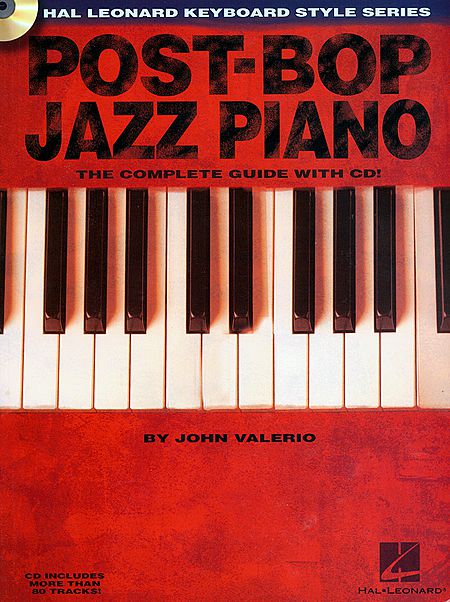
That fire truck red book on the bottom of the pile is a really good jazz piano book, one that I haven’t played out of in ages, Post-Bop Jazz Piano by the Hal Leonard Corporation. And as it peeked out at me, it gave me a really great idea: What would happen to my piano skills if I worked exclusively with this book, and maybe just a few tunes now and then, until I worked my way through the entire book? Would I get good? Would my jazz idioms impress instead of depress? Would I be able to play like Chick Corea? It’s an interesting proposition. I don’t think I’ve ever played through one piano instruction book exclusively before. I have worked all the exercises in Hanon, but that didn’t help nearly as much as I hoped. I know this book has good stuff in it. There might be some value in just playing “in the style” that the book purports to teach. It might even be enough to keep me working at it.

My brain immediately fought to quell this idea. You’ll work through the book, you’ll only get a little better, then you’ll be done with that book. Then what? But I already had the answer: I own two more books in that series, and there’s probably another dozen books in that series that I could own. It might be worth a shot. My piano instructor and I actually worked from this book a few times. And if I get good at working through books, there’s more and more of them to work through. Plus, I can gauge how long it take me to work through one of these things, then see if I can get any faster with the next ones. Anyway, how could I not get better working through an instructional book? Bottom line is, I haven’t had a clear idea of what or how to practice since I stopped studying at UAH. This is a method I’ve never tried before, so it might work. I mean, really, it’s not a bad idea.

So that’s what I’m going to do. Stay tuned.

Saturday, February 5, 2011

Advanced Jazz CD Collecting: A Quick “How To”

The basis for my jazz music collection has always been the Penguin Jazz Recordings Guide’s “Core Collection”. Remember that I started out in jazz without owning a single jazz album, except for three culled from a Wall Street Journal article about “must have” jazz recordings and some average stuff borrowed and burned from the library (I don’t do that anymore, so don’t call the FBI.) . So using the core collection of the Penguin Guide eighth edition, I began buying jazz CD’s.

As is to be expected with a list like the core collection, probably more than half the CD’s are common, relatively inexpensive, and easily found on amazon or ebay. But as you pick what I call the low hanging fruit, you are left with high hanging fruit that gets increasingly harder to find and more and more expensive. Some of the recordings are downright rare, and as I’ve written before, some can’t be had for love or money. They just aren’t out there. Be that as it may, I am dangerously close to completing the core collection with only one or two substitutes, but no integral gaps from the 188 selections.

Notice there that I say “selections” because some are multi-disc sets and some recordings are now available either as parts of boxed sets or other compilations. That complicates matters. So here’s the “how to” for completing the core collection:

1)  Get the easy ones first. Lots of artists can be had for just a couple of bucks: Bill Evans, Miles Davis, Duke Ellington, Count Basie, etc. Most every selection on amazon will have a “People who bought this also bought…” underneath with a bunch more of the selections you will need to complete the collection. Pick up what you need.
2)  Buy used. Used CD’s are almost always half the price of new, or less. There are some CD’s I literally picked up for the cost of shipping. 
 3)  Keep track of what you have and what you don’t. You will quickly form a mental database that will help guide your search and will alert you when you come across something rare or hard to find.
4)  If you see one of the rare ones, buy it. You have to convince yourself that money is not an issue here, because there are some that I have seen and failed to purchase because I thought it too expensive, and then I never saw the thing again. It’s frustrating. More frustrating than breaking the budget.
5)   Search ebay and amazon everyday. The foreign amazon sites are also worthwhile. I found some on amazon Japan that I couldn’t find anywhere else. Use the wishlist (amazon) and watchlist (ebay) to keep your eye on prices and availability.
6)  Spend the time and money.
7)  Listen and enjoy your collection. You deserve it.

Depending on the availability of one or two CD’s and whether I opt to substitute or not, I should finish my core collection by the end of March. I plan to take a picture of me sitting in the middle of all those CD’s. It’s going to be exciting.

Wednesday, December 16, 2009

A book review

In case you haven't read my review on Amazon.com, here's what I wrote about Terry Teachout's new book, Pops, which is about Louis Armstrong. Teachout is a regular contributor to the Wall Street Journal who doesn't write specifically about jazz, but often touches on the world of jazz in his cultural musings column, Sightings. This book was really interesting, had a lot of previously unpublished photos, and was a really keen look at the inside of the jazz world in its formative years. The sections about Louis and Miles Davis are strangely compelling and scary (they didn't get along), but cast in the light of one generation leading to another, jazz fans will see they should be thankful for both of these trumpet greats in the context in which they played and developed their own music. Anyway, it's a very good book and I highly recommend it to any jazz aficionados looking for a good way to kill a few hours of free time over the coming holidays.


"Among regular contributors to the Wall Street Journal, there are a number of jazz writers who are almost legendary in the jazz world. That makes this book by Wall Street Journal columnist Terry Teachout all the more extraordinary, as Mr. Teachout is not specifically a jazz critic. Although his "Sightings" column has been known to cover many jazz subjects, one wouldn't necessarily expect the level of scholarship and depth that Mr. Teachout achieves with "Pops". But for me, what makes this book so good is that he is able to relate the life of Louis Armstrong through the music that Louis made. Not only the when and where, but the who and the why are covered in no small detail. (If you are a fan of Armstrong or jazz and don't have his recordings, you can pick up something like The Complete Hot Five and Hot Seven Recordings to listen to the songs that Mr. Teachout documents so well.) It makes for fascinating reading (and listening), and yet, the information is contains is enough to qualify it as a textbook on jazz history. Anyone who reads this book will definitely come away with a great respect and awe for Mr. Armstrong, but that reader will no doubt also have a better light shining into the dark closet of jazz that allows him to see the evolution of the music as well as the development of some of the legendary jazz performers (and producers, and wanna-be's) of Armstrong's time. Being "late to jazz" as I am, I feel like I have a lot of catching up to do to learn more about jazz music and history, but after reading this book, I feel like I not only caught up, but I might be ahead of quite a few individuals as well. Anybody who is looking for an interesting biography, or a window onto the world of music entertainment in the 20th century, or of course, jazz, would do good to buy and read this book. Mr. Teachout has written a great book that I'm sure will be enjoyed by many."